Sunday, 8 May 2016

In Defence of Motherhood (and Mother's Day)

In the lead-up to Mother’s Day in recent years, it seems there are plenty of articles, blogs, and reflections about all that is wrong about Mother’s Day as we observe it.  One particularly poignant post I read reflected on how having a day to celebrate mothers dehumanizes women who do not have children and makes them feel like failures.  Even Anne Lamott, who I really respect, has written a scathing attack on Mother’s Day and mothering.  Those articles have stayed with me, and I admit that I have some very mixed feelings. 

First of all, some disclaimers.

Disclaimer #1: My family isn’t really into over-the-top celebrations.  Our wedding was pretty low key, we rarely had big traditional birthday parties for our kids, and even Christmas, compared to almost everyone else, is, for us, mostly a time to slow down, rest, relax and be together.  I am not a creative decorator, and although I love to cook and bake, it is a stretch for me to make any of those wonderfully dramatic birthday cakes you see on Pinterest (or at almost any other kid’s birthday party).

Mother’s Day, especially, is almost non-existent in our family, because it almost always falls on Convocation weekend, the busiest weekend in my husband’s professional life.  I’m lucky if I see him for more than a couple of  hours from Friday morning until Monday night.  Because of this, fairly early on, my husband and children decided that they would have a “surprise” Mother’s Day for me, so it happened any time between the beginning of May and the middle of June, and usually consisted of cards, chocolate, small gifts, and maybe breakfast in bed. 

Disclaimer #2: I am not one of those women who will threaten to leave my husband if I don’t get a new piece of jewellery or a spa day every anniversary or birthday or Mother’s Day.  For one thing, we are not in that income bracket.  But mostly, that’s just not who I am.  My family knows that all I really want on Mother’s Day, or any day, for that matter, is a nice piece of chocolate and a little bit of love (or this year, some really cheesy garlic fingers and pizza).  So I am not defending the commercial idea of Mother’s Day as a day to get me some new bling.

Disclaimer #3: I love being a mother.  It is the most honest thing I’ve ever done.  Being a mother has changed me in a thousand ways that I could list for you, and probably another thousand ways that I’m not even aware of.  I have never regretted our decision to have children, and, although it has been difficult financially and socially at times, I have never regretted my decision to stay home with my kids.

However...

In these days of political correctness and radical inclusiveness, there are a few attitudes about “motherhood” that make me feel defensive and apologetic and guilty, sometimes all at the same time.

First, and most annoying as far as I am concerned, I am constantly informed that having a “furbaby” is as valid a form of motherhood as having a human baby.  Really?  Does a “furbaby” come home crying from school because the other “furbabies” were mean to it?  Or because a “furboyfriend/girlfriend” just broke up with it?  Do “furbabies” spend a lot of time stressed out because of all the wicked things that happen in the world, and all the choices that lie in front of them, and all the pressures to succeed?  Do “furbabies” suffer with mental health issues?  I apologize; I realize that pets are important parts of people’s lives, and I do not want to minimize the very significant impact that pets can have on a family.  But it doesn’t matter how much you love your pets or how much you attempt to humanize them, having a pet is nothing like having a child.  Nothing.  And I am insulted by the inference that parenthood is that simple.

Second, some discussions about how Mother’s Day affects women without children make me feel guilty and apologetic.  And resentful for feeling that way.  I once attended a church service on Mother’s Day where the (female, unmarried and childless) minister spoke bitterly about how alienating Mother’s Day was for her, as she had neither children nor a good relationship with her own mother, and how insensitive and selfish it was for mothers to basically flaunt their motherhood in the faces of those women who were not mothers.  She made it appear that not having children was somehow a massive failure, and she made me feel guilty and selfish for having children and a husband when she did not.  I admit, I was angry after that sermon.  Instead of taking the opportunity to talk about the nurturing and yes, mothering qualities that a healthy church and community should have, and instead of acknowledging and encouraging and supporting the young mothers in the congregation, she left me (at least) feeling that I needed to apologize for my choices to marry and have children.  (And here I insert Disclaimer #4 – I would be very happy if churches did not “celebrate” Mother’s Day and Father’s Day.  But if they have to, there are plenty of ways that they could be much more theological about it). 

Let me be perfectly clear.  My heart breaks for those women (and men) who have lost babies and children, or who desire children but cannot have them.  I weep with those parents whose children have gone down dark roads, or who suffer from debilitating and life-threatening illnesses.  I completely understand that the way our society “does” Mother’s Day can be alienating and hurtful for many women, for various reasons. 

But although I empathize with these women, I do not believe that their circumstances should minimize my own mothering.  I have been fortunate.  I have a loving and supportive partner in parenting, and my children have (so far) been healthy, mostly happy, and are now independent and following their own life paths.  But being a mother is bloody hard sometimes, and I suspect that for many, many mothers, it is done without any encouragement, validation or recognition.

I have friends who don’t have children, including an aunt and one of my closest friends.  Though they might not realize it, they have each “mothered” and nurtured and supported me and my children significantly.   I do not think less of them because they do not have children.  Their lives are not any less meaningful or real or fulfilled than mine.

Third, among modern mothers, there is a great deal of tension.  It seems to me that in recent years, motherhood has become much more polarizing.  On one end of the spectrum, we have the “good mothers.”  They use cloth diapers, breastfeed exclusively as long as possible, feed their babies organic homemade baby food, and they practice “attachment parenting,” “co-sleeping” and “baby-wearing.”  They are super-involved in their kids’ schools, sports teams, play groups, and well, their entire lives.  On the other end of the spectrum, there are the “bad mothers”: those who use formula and disposable diapers, who stock up on store-bought baby food, and who plant their kids in front of the tv with a bowl of potato chips because they JUST. NEED. FIFTEEN. MINUTES. OF. PEACE.  Or, as in Winnipeg recently, they let their children play outdoors UNSUPERVISED.  Or even worse, they go back to work and their children are left in the care of others.  Motherhood has become a competition, a judgmental battle of moral (and economic) superiority.

The Conflict: How Modern Motherhood Undermines the Status of Women, written by French feminist Elisabeth Badinter in 2010, discusses this last point.  She looks at motherhood through a completely feminist lens and argues that the zealous dedication of modern mothers actually “tethers” them to their homes and children to an extent that hasn’t been seen since the 1950s, before modern feminism really took root.  Although I disagreed with much of what she wrote, I found myself agreeing with much of it too.  Badinter argues that the choices that modern day “good mothers” make have actually marked a significant regression in women’s rights.  She writes “... there is no denying that male domination persists... [Women’s] increased responsibility for babies and young children has proved just as restrictive, if not more so, than sexism in the home or in the workplace... The tyranny of maternal duty is not new, but it has become considerably more pronounced with the rise of naturalism, and it has thus far produced neither a matriarchy nor sexual equality, but rather a regression in women’s status.  We have agreed to this regression in the name of moral superiority, the love we bear for our children, and some ideal notion of child rearing, all of which are proving far more effective than external constraints... there is nothing quite like voluntary servitude.  And men have not had to lift a finger to accomplish this fall.  The best allies of men’s dominance have been, quite unwittingly, innocent children” (pp 96-97).  In other words, if I am interpreting her correctly, the way that modern mothers choose to be mothers, dedicating themselves completely to every need of their children, is actually detracting from struggles towards equality, and supporting “male domination” in our society. 

That’s a pretty provocative statement, and as a woman who chose to stay at home with her children (and who breastfed, used cloth diapers, and made baby food), my initial reaction was pretty negative.  But after some reflection, I think her point is that the modern motherhood movement seems to have lost all sense of balance and common sense.  Many modern mothers have dedicated themselves to their children to the extent that they have lost their own identities and any sense of being independent people.  In doing so, we create children who feel entitled to having every moment of attention focussed on them, from the day they are born, because we make sure that every need is immediately met, they have the best of everything, and every possible intervention is provided, even if it isn’t really needed.  We raise children who are incapable of becoming independent adults without a great deal of assistance. Motherhood should include, as Signe Hammer wrote, “taking care of someone who is dependent and at the same time supporting that person in his or her efforts to become independent.”  And even though Badinter is more concerned with the status of feminism than she is with family dynamics, I think we can also agree that these expectations of what makes a “good” modern mother has created a huge disconnect among parents, women who can afford to stay at home with their children and those who can’t, those who believe their place in the working world is as valid as their place in the home and those who choose to stay at home, and among mothers of different socio-economic groups.

If I was a young mum today, I’d definitely be at the “bad” end of the scale.  I chose an obstetrician over a midwife and had my babies in hospitals.  My kids thrived on a schedule, including feeding, they slept in their own rooms from the beginning, in a cradle and then a crib, and although I believe in the power (and the importance) of baby snuggles, I was not a baby-wearer.  I would not have been able to cope otherwise, not because my children were demanding, but because that is not who I am.  I made the choices, with my husband, that I believed were the best ones for me and my family, and I regret none of them.

Would I care if society “cancelled” Mother’s Day?  Honestly, I wouldn’t.  But I have two great kids and a husband and a whole network of people out there, women and men, who consistently affirm me as a mother AND a woman.  There are many mothers who are raising children by themselves.  Or who have kids who are sick.  Or kids (or spouses or others) who treat them with disrespect or are rude and sassy.  Or families and networks that are just not supportive.  Instead of competing with each other, and discussing who is doing it “right” and who is doing it “wrong,” we should be encouraging each other, and respecting the judgment and ability of women to make the decisions that are right for them, and for their children, even if they are not the decisions we would make ourselves. 

So here’s my bottom line.  Motherhood is not easy.  It isn’t always rewarding.  One day a year to honour the nurturing and loving qualities of mothers, and everything that is good about motherhood, doesn’t seem like a lot to ask.

On Mother’s Day, I will celebrate those women who have been mothers to me, first and foremost, my own mother, but also my mother-in-law, my aunts, my friends, and all the other women in my life.  I will celebrate my own motherhood, the joys and blessings, the challenges, the many ways motherhood has changed me for the better.  I will celebrate, and say a prayer for, the mums who are struggling or who feel that they are failing, but still wake up every morning determined to do the best that they can for their families.  I will celebrate the fact that every one of us, male or female, mothers or not, has the capacity to “mother” children through kindness, hugs, snuggles, reading to a child, listening and caring.  I will celebrate the presence of so many wonderful “mothers” in my life and in my children’s lives.  I will celebrate the legacy of my grandmothers and my great-grandmothers, women who were pioneers and truly knew what it was to sacrifice for their families, women of strong faith and strong character. 2019 Edit: I will also celebrate refugee mothers, who have left everything behind, their kinship networks, their customs, their homes, who have faced the unknown and unfamiliar future in a strange country for the sake of their children, sometimes with their husbands and sometimes without, with strength and courage and generosity. 


Happy Mother’s Day.

Motherhood brings as much joy as ever, but it still brings boredom, exhaustion, and sorrow too.  Nothing else ever will make you as happy or as sad, as proud or as tired, for nothing is quite as hard as helping a person develop his own individuality – especially while you struggle to keep your own.
        – Marguerite Kelly and Elia Parsons


Friday, 1 April 2016

Kitimat

I’ve been feeling nostalgic lately, and this morning I was listening to some music that took me back to my childhood.  Specifically, it took me to Grades 2-5 in the northern British Columbia community of Kitimat, in the 1970s.

Music and Kitimat are tied together for me.  Our music teacher’s idea of “teaching” music was basically to print out the words to all the top hits of the day and have us read them as he played the recordings.  Some of the songs I remember are Cher’s “Cherokee People” and “Gypsies, Tramps and Thieves”, “Raindrops keep falling on my head” by BJ Thomas, “Sweet City Woman” by the Stampeders, “I can see clearly now”, “Black and white”, and most significantly for me, Gordon Lightfoot’s “If you could read my mind” (he has been my go-to favourite ever since).  I was also in a large children’s choir in my church, eventually moving up to the more select Girl’s Choir.  And I started piano lessons while we lived in Kitimat.  When I hear hits from the early 70s, I think of Kitimat.

Kitimat is an industrial town at the head of the Douglas Channel, literally at the end of the road, built in the midst of old growth forests in the 1950s by Alcan to facilitate the production and transportation of aluminum.  When I lived there, Eurocan also operated a pulp and paper mill.  The factories were well out of town, but occasionally, the scents of industrialization wafted over our neighbourhood.  It is coastal, but so far up the Channel that it is actually quite a distance inland from the open Pacific.  Kitimat is almost completely surrounded by mountains, except for the sliver of the Channel. 

My dad was the minister of the Baptist Church.  It was a well attended, active, multi-generational church, mainly post-war German immigrants hired to work at the aluminum smelter.  There was also a small group of Portuguese immigrants.  Kitimat is where I was introduced to Portuguese sweet bread, fisherman’s stew, homemade German Black Forest Cake, and Rouladen (I also associate Kitimat with very good food).  We had a lot of fun at church in Kitimat, and at Christmastime, I remember the glorious carol singing and the beauty of the advent wreath which was suspended (magically, it seemed to me) in midair at the front.

Moving from southeastern Saskatchewan to northern coastal British Columbia represented, to say the least, a massive change of scenery.  We went from almost endless sunshine and blue sky to short days and a lot of rain.  Wikipedia says about Kitimat that it “has a very wet oceanic climate, albeit close to continental with significant temperature difference between winters and summers. The winters hover around the freezing mark, bringing snow.”  You could say that.  In fact, one of the winters that we lived in Kitimat, it snowed almost 40 feet over the winter, and we had a record snowfall of 112 cm in 24 hours in February 1972.  The snow was wet and heavy, perfect for kids who liked to build snow forts and tunnels, but not so perfect for people who couldn’t get the snow removed from their roofs quickly enough.  I can recall climbing up the snowbank to the top of our roof and sledding down the other side to the street level.   I also recall hearing about people whose roofs collapsed under the weight of the snow. 

We moved from the wide open prairies to tall dark forests and mountains.  The wildlife was different (there are no grizzly bears in the prairies, and no antelope in the mountains).   The food was different (fresh coho salmon, oolichan and halibut).  The adventures were much different.  My memories include afternoons spent hunting mushrooms in the forest, exploring abandoned mine sites in the mountains, and I still have some fossils and petrified wood that we found around Kitimat.  One of my uncles and his family lived down the highway a bit in Prince George.  We took advantage of their summer cottage at Cluculz Lake, where I caught my first fish and saw cougars in the wild (the first and only time in my life).  The drive from Kitimat to Prince George, through the Skeena River Valley past the Seven Sisters Mountains, was breathtakingly beautiful.  One of our favourite stops along the way was at the nearby hot springs at Lakelse.  There’s nothing quite like sitting in an outdoor pool in a swimsuit in the middle of winter.  Another favourite stop was near Hazelton at the ‘Ksan Historical Village and its totem poles and beautifully decorated houses.  Kitimat is in the traditional territory of the Haisla people, and I think it was probably here that I first became aware of traditions and cultures of some of Canada’s indigenous peoples.

I went from attending a traditional prairie town school with 4 grades (a 2 storey building with a central hall and 2 classrooms on each side of the hall), to a large, relatively modern school with grades from Kindergarten to grade 6.  I think it must have been a pretty good school; although the music programme was lacking in actual teaching, we had an awesome art class, including a real working pottery wheel and kiln, and I have a scar on my leg from a third degree burn I suffered in grade 4 chemistry when we were boiling something in flasks over open bunsen burners.  We had real gymnastics equipment and I can recall being airborne over the trampoline.

Kitimat is also where I first remember experiencing loss.  Although my beloved grandmother died two years before we moved to Kitimat, I do not recall my reaction to her death beyond a feeling of bewilderment.  In Kitimat, the teenaged sister of a classmate committed suicide, a man from the church fell off a boat and drowned, and a woman who was very active in the church, and a friend of my mother’s, died in a fatal car accident.  Her daughter, who was around my age, was seriously injured.  This is where I became aware of the tenuousness of life, and correspondingly, the importance of making the most of each new day.

I have no idea what Kitimat is like now.  I haven’t been back since we moved; it isn’t an easy place to get to.  But I recall my experiences there, my friends, my school, the scenery, my neighbourhood with a great deal of fondness.  One day, I would like to go back and see Kitimat through adult eyes.  In the meantime, I’ll continue to be reminded of my life in Kitimat whenever I hear hits from the 70s.


Tuesday, 15 December 2015

An Amazing Experience

I want to share an amazing experience with you.

In September, the world was shocked and horrified by images of the small dead body of Aylan Kurdi, the 3-year-old Syrian boy who drowned with his mother, Rehana, and brother, Galib, as they tried to flee from Syria via Turkey to Europe, hoping eventually to end up in Vancouver.  There were the to-be-expected reactions, people who felt it was inappropriate to publish images of dead children, people who wrung their hands and said “What is the world coming to?”, and I’m sure there were many people who also felt that this problem was much too big for me to handle and nothing will change so I’m just going to forget about this and move on with problems I can solve.

But for some reason, the photos of this dead child, and the fact that his family had been trying to reach Canada for years, really galvanized many people.  For me, it began with a dinner conversation with my husband, asking each other if there was anything we could do to help make sure that there are no more photos of dead babies washing up on the shores.  We knew we couldn’t do anything on our own, as much as we wanted to.  So we decided to call a Town Meeting, open to the public, to see if there was anyone else in our town who felt the same way we did, and to see if we might work together to offer a refugee Syrian family a new home and new hope.

We have lived in this small town of 5500 people (plus 2200 university students) for 22 years, and we know that there are many gracious, warm-hearted, generous people living here.  We hoped that perhaps there might be 40 or 50 people who would show up.  In reality, we expected about 25.  After all, people are busy raising children, volunteering, working at their careers, and a myriad of other things.  We hoped that maybe, with a small group of people, we might be able to raise enough money over several months to eventually bring a family to our town.

The meeting was called for a Sunday night in late September.  Almost 100 people showed up, and another dozen or so contacted us to say that they were unable to attend but they wanted to help.  At the end of that meeting, which included information about the Syrian situation and refugee sponsorship, the gathered community members were asked to consider 3 questions:  Is sponsoring a family in Sackville the right way to proceed?  Do we have here and beyond, the collective will to support a family?  And if yes, should we form a Steering Committee?

I waited with bated breath as the crowd contemplated and discussed these questions in small groups.  And then my husband asked the group to reassemble, and the answers were given.  Each question received an overwhelming and resounding “yes.”  And that’s not all.  The crowd enthusiastically endorsed consideration of sponsoring not just one family, but two or maybe even three.

Shortly after, the Steering Group was organized, with my husband as Chair, and me as a member, and we got things underway to figure out how to finance and support a refugee family.  The Steering Committee has met weekly, we have held two additional public meetings,  and several working groups have been formed and tasked with specific responsibilities such as fundraising, communications, housing, welcoming and orientation, to name a few.  At the moment, we have almost 100 people actively working on those committees, with more people becoming involved every day.

Two months later, we have raised enough money to submit our first application, and almost certainly by the end of the year, we will have enough for a second application.

This in itself isn’t overly remarkable.  In many other small towns in Canada and probably elsewhere in the world, similar things are happening.

We live in a small university town.  While our students and our townspeople generally get along well, it is fair to say that there has been a bit of a rocky history between Town and Gown in recent years.  The university is a major employer and the professors are largely CFAs (Come From Aways) and have a higher level of education than the average townie.  Occasionally, this causes some resentment, although townspeople are quick to admit that the town benefits in many ways by having the university here.  Because the university is full of experts and scholars, sometimes projects which are supposed to be collaborative turn into projects that are highly directed and influenced by the university.

So when we decided to host our first public meeting, at the University Chapel, we wanted to make sure that we emphasized from the first minute that although we were hoping the university community and the University itself would be active and engaged participants, this was not meant to be a University Project.  If it was to succeed, it would have to be a truly collaborative venture involving many different aspects of the town. 

In that context, one of the things that makes this coalition so remarkable is the high degree of collaboration, excitement, and dare I say, even camaraderie within our community.  Almost everyone wants to participate, to “do their bit,” to the point that people have spotted my husband walking in town and pulled over in their cars so they could jump out and volunteer for something.  Our committees have ordinary folks from the town working side by side with university administrators, students working with clergy, retired folks working with young professionals, professors working with store clerks.  This level of collaboration is, I believe, practically unheard in our town.

Another thing that moves me is just how many people with specific skills have volunteered to participate.  A retired quartermaster is helping head up the committee responsible for collecting, organizing and storing household items.  How great is that?  Freelance journalists and writers have volunteered to organize communications.  Artists have designed wordmarks to make our name immediately recognizable and produced cards and letterhead for us to use.  A number of Arabic speakers have volunteered their translation services.  Who knew there would be more than one Arabic speaker in a small Maritime town??  One of the people on our Steering Committee has just recently retired from a career working with Citizenship and Immigration Canada.  Her area of work?  Helping process refugees. 


My experience working on various committees is that they tend to be pretty insular.  A committee is formed to work on a project, the ideas generally come from within that small group of people, and reports are made to Boards or to organizations or to bigger committees.  There isn’t a lot of room for outsiders to actively participate unless they are specifically asked to do so by the committee, there’s not much opportunity for organic creativity from outside the committee.  This coalition, however, has inspired brilliantly creative initiatives from a variety of groups and individuals.  Our local Farmer’s Market, for example, recently had 100 canvas bags manufactured to promote the market.  They decided to sell these bags for $20 each.  That $20 will be turned into a $20 voucher for goods from the Farmer’s Market, and those vouchers will be turned over to our families for their use.  The Market vendors’ reasoning is that not only will the Farmer’s Market benefit from having increased publicity, as you would expect, but also – and the fact that they so carefully considered these things really touched me – that the new families would be introduced to good, local, fresh food, and most importantly, would be immediately enabled to begin to form relationships, not only with the vendors, but also with regular market-goers.  (And by the way, on their FIRST MORNING of sales, they sold 79 bags, and 4 days later, I hear there might not be any left). 

Other community groups have donated freewill offerings to our coalition.  A drama production commemorating Remembrance Day (our first influx of cash!) and a Christmas Concert by our local citizen’s band are only two examples.  Sunday school children made cookies and sold them at the last Midnight Madness.  Word is that the high school is holding a week long bake sale.  The university library is donating its book fines.  And the list goes on.

Individuals have made financial donations, big and small, and every dollar has helped.  Others have donated time and resources.  An expert knitter has volunteered to knit mittens and scarves, which will be much appreciated when our families arrive in the middle of a Canadian winter.  Some of the football players from the university have volunteered to help move furniture when the time comes.  People have volunteered to provide transportation, to care for children, to teach English and provide tutoring.  A former university student, who is from Syria, wants to be here when our first family arrives.  There are so many more examples of people filled with enthusiasm and goodwill, that it is truly overwhelming.

We do face challenges.  We don’t know what situation our families will come from, whether they will be dealing with the aftermath of trauma and violence.  We remind ourselves that they haven’t chosen to leave their homes, they simply didn’t have a choice; so while we are excited they are coming here, they will almost certainly have a mixture of feelings which includes sadness at the prospect of leaving their homeland forever.  They might decide that they want to live in a bigger centre, with a mosque if they are Muslim, or a place with more ethnic diversity.  And there are one or two citizens who are not happy to welcome refugee families, and they have gone out of their way to spread their ignorant bigotry to try to create hatred and fear in our town.

The good news is that the positives vastly outweigh the challenges.  The negative responses have been so negligible and almost pathetic (really, only one person consistently, out of the entire town) that they have done nothing to dampen the spirits of the rest of the community (in fact, I think they have made some of us more determined than ever).  And, as one of the Steering Committee members reminded us recently, these families are coming out of desperate situations.  Whether they successfully integrate into our town, or somewhere else, our community has come together in this time and this place to give them the greatest gifts we can imagine – the gifts of hope, joy, peace and love, and most importantly, the gift of life.  And that’s what this season of Advent, leading up to Christmas, is about.

I am beyond proud of our town, of the generosity of spirit and the commitment being shown to people who so far, remain perfect strangers.  I am exceedingly grateful to be a small part of this overwhelming, exciting experience, which will be life-changing not only for our new families, but also, I’ll wager, for the rest of us.

For me, this is true Christian hospitality, a gift that invites people to come in, simply because they are God’s people.  We invite them in because they have needs, and we can provide assistance; and we invite them in also recognizing that we might be changed by them, by our encounter with them, and that the divide of “us” and “them” might itself be broken down.

I can’t wait to welcome our families in person. 


Thursday, 20 August 2015

My faith and my politics

Well.  I wasn’t going to turn my blog into a political platform.  However, I have been accused of being anti-Christian or anti-Biblical because I have made no secret that I am staunchly anti-Harper and I am hoping that the Conservative government will be booted out of office in less than two months.  I am sure I’m not the only one.

The Christian right, as you might know, supports Harper because he claims to be a Christian, and he is pro-Israeli (which is important to the Christian right because in order for Jesus’ second coming to occur, Israel has to have political control over Jerusalem – and that is a vastly over-simplified explanation).  There might be other reasons they support Harper, but those are the two biggies. 

I also claim to be a committed Christian.  My faith is central to everything about my life.  I am not perfect, in fact I am far from it, and I would never presume to think that I know why things happen and why people are the way they are.  But I think it is important, even in all my imperfections, that I take an opportunity to outline why I am not and never will be a Harper supporter, and why I believe that my position is supported by my Christian beliefs.

Several times now in the past few months when I have posted anti-Harper opinions on Facebook, I have been reprimanded by some of my friends with reference to the Bible verse that tells us that we should pray for and support our leaders.  I assume that this refers to 1 Timothy 2, which reads: First of all, then, I urge that supplications, prayers, intercessions, and thanksgivings be made for everyone, for kings and all who are in high positions, so that we may lead a quiet and peaceable life in all godliness and dignity. This is right and is acceptable in the sight of God our Saviour, who desires everyone to be saved and to come to the knowledge of the truth.  Or the passage from Romans 13: Let every person be subject to the governing authorities; for there is no authority except from God, and those authorities that exist have been instituted by God. Therefore whoever resists authority resists what God has appointed, and those who resist will incur judgment.

I always respond with a comment along the lines that I am praying for Stephen Harper.... in fact, I am praying really hard that after October 19, he will no longer be the leader of our beautiful country, and we can go about trying to repair some of the damage his government has done.  As you can imagine, this is not the response that I am supposed to give, as a “good” Christian (me being a “good” Christian is a whole other issue...).

According to my friends, these passages say that our authorities are given power according to God’s will, God has a plan and a mission for these leaders, and if I speak out against them or “resist” their leadership, I am going against my Christian faith.  As Christians, then, we are to prayerfully support our leaders, without question and without criticism.  Maybe that’s a good principle.  But let’s examine that a little bit.  According to that interpretation, if Hitler, Idi Amin, Osama bin Laden, Stalin, Pol Pot, Mussolini, Ghadafi, Marcos, Castro, or Duvalier, just to name a few, were my leader, I would be obligated to prayerfully support their ideals and their actions, because the Bible tells us to.  (Or does the Bible actually mean it only applies to Christian leaders?  Because if that’s the argument, I would like to point out that those passages were written when non-Christian governments, i.e. the Romans, were in power in the Holy Land, so if you are going to be literalist, it must apply to any and every governing authority).

I am not a theologian, but I do think a lot about what I believe and how that should affect my daily life.  I think about someone like Dietrich Bonhoeffer, a Lutheran minister of the gospel in Nazi Germany, who stared evil in the face, and decided that as a Christian, he could not prayerfully (or morally) support the evil he observed in his country’s leader; he was ultimately executed by his own government for daring to try to eliminate the evil influence from his country.  I think of someone like Archbishop Oscar Romero, who spoke out against the government-sponsored injustices and murders taking place in El Salvador in the 1970s and 1980s, and was assassinated for living his faith.  Their actions clearly did not support the biblical injunctions to submit to the governing authority.  Although the issues facing most Canadians are very different from those in Nazi Germany or El Salvador, I think I am in pretty good company when I say that my very faith will not allow me to support any leader who promotes hatred, distrust, corruption, dishonesty, injustice, or any other morally reprehensible behaviour, whether they are Liberal, Conservative, NDP, Green or Rhino.

I base my personal faith on the New Covenant that was made through Jesus.  I try to think about what Jesus taught through his words, his life, his interactions with people.   The Jesus that I know didn’t teach hate.  The only time he got angry was when he was faced with hypocrisy and injustice.  The Jesus that I know taught love and justice for all.  In fact, he went out of his way to show love for every marginalized person he met.  The Samaritan woman at the well.  The tax collector. The adulteress.  In 2015, maybe we could include the aboriginal woman who is missing or murdered.  Or the person struggling with mental health issues.  Or the homeless person.  Or the Palestinian.  (Would Jesus have sanctioned the killing of Palestinians, many of whom are innocent children and bystanders, by western-backed Israeli governments?  Would he?  I think not.  Even for the sake of Jerusalem.  My tax dollars, and yours, support this injustice.  To me, that’s a sobering thought.  And it’s only one of many injustices.  That’s even more sobering.)
 
I cannot speak for other faith traditions, but for those of us who profess to be Christians living in a democratic society, I believe that we have the responsibility to elect leaders, regardless of their personal faith traditions, who reflect the values our faith teaches.  I believe that as Christians we have a responsibility to reflect on whether our current government’s actions and policies truly reflect the ideals that Jesus taught and lived.  If we support leaders who are dishonest, hypocrites, cheaters, liars, and willing to sacrifice the welfare of others for their own gain, I believe we will be individually and collectively judged for that support. 

Walter Rauschenbusch was a theologian of the social gospel a little over a century ago.  He told a parable based on the story of Pontius Pilate, who washed his hands in front of the raucous crowd demanding that Jesus be crucified, a symbol that he was relinquishing his responsibility to take a stand, and delivering Jesus into the hands of the crowd. 

On the eve of the crucifixion Pilate’s Washbowl disappeared from the palace. Nobody knows who took it. Some accused Judas Iscariot of selling it; but that is plainly a libel, because Judas was honest enough to go and hang himself. At any rate, ever since that time, the Washbowl is abroad in the land, carried by infernal hands wherever it is needed, and people are constantly joining the invisible choir which performs its imperceptible ablutions therein. The politician who suppresses principles because they might endanger the success of the party; the good citizen who will have nothing to do with politics; the editor who sees a righteous cause misrepresented and says nothing, because it might injure the circulation; the deacon who sees a clique undermining a pastor’s position and dares not create a disturbance ... All of these are using Pilate's Washbowl.

In the last election, 61.4% of eligible voters chose to exercise their right to vote.  Of those, 39.62% voted for Stephen Harper’s government.  I am no mathematician, but by my figuring, that means that only about 25% of Canada’s population actually elected Harper’s Conservatives.  That does not sound like a healthy democracy at work.  So I am advocating for change that starts with voting.  People have fought for our right to vote.  We owe it to our loved ones, our aging parents, our spouses, our children, to vote, and to vote wisely.  We owe it to our society to take a stand, to not be the people who are washing their hands in Pilate’s Washbowl.  And we owe it to our society and our country to hold our leaders accountable after the election, no matter who is elected.

I do not expect everyone to agree with my views, just as I do not agree with everyone else’s views.  But that is part of living in a democratic country.  And if anyone wants to criticize me for being anti-Christian or anti-Biblical, I will point out that for me, as a Baptist, my right to vote and to advocate according to my beliefs and my conscience is part of my legacy of soul liberty, which very simply means that I answer only to God on matters of conscience and faith.  That means that I also must respect every person’s right to soul liberty, no matter how much I might disagree.  A friend of mine often uses a quotation that is attributed to Voltaire: “I disapprove of what you say, but I will defend to the death your right to say it” – an appropriate quotation for both a Baptist and a believer in democracy.

And yes, no government is perfect, and the federal Liberals have a lot to answer for too.  But I respectfully disagree with those who believe that the Conservatives have enacted God’s plan for Canada. As is my right.


Friday, 17 July 2015

The prairies

I spent a large portion of my growing up years on the prairies, in Saskatchewan for four years, and in Manitoba for six years, with another two years in the foothills of Alberta.  When I moved away, thirty plus years ago, I left a little bit of myself there, and I have never really felt whole since.

This summer, to celebrate our 30th anniversary, my husband and I decided to return to the prairies, where it all started for us.  We had an amazing, refreshing, nostalgic twelve days in Manitoba (including a weekend foray to Regina), spending time in the city, the country and the beautiful Riding Mountain National Park, with friends, family, and with each other. 

While we were there, I compiled a list of all the things I miss about Manitoba.  Some of these things do not in themselves make Manitoba different from other places, but the sum of them all is uniquely prairie. 

So here, without further ado, and in no particular order, is my list.

•    Ukrainian churches
•    Mennonite food
•    Stucco houses
•    Enormous old trees rising out of the fields, probably elm or oak...
•    Black, black earth
•    Brilliant yellow canola fields stretching literally as far as the eye can see


•    Ditto for wheat fields (at this time of the year, a gentle green, but slowly ripening to a soft golden colour)
•    Decent highways... the worst highways in Manitoba are still better than some of the best highways in the Maritimes
•    Watching an oncoming vehicle for 5 miles
•    Oceans of flax
•    The slightly skunkish smell of canola and the sweet smell of clover
•    Dusty gravel roads – and being able to watch a vehicle’s path by following the dust trails on the horizon
•    Crops we saw: flax, canola, wheat, barley, beans (soybeans?), sunflowers, potatoes, alfalfa, corn

•    Hutterites
•    Jackpines
•    Back alleys in the cities
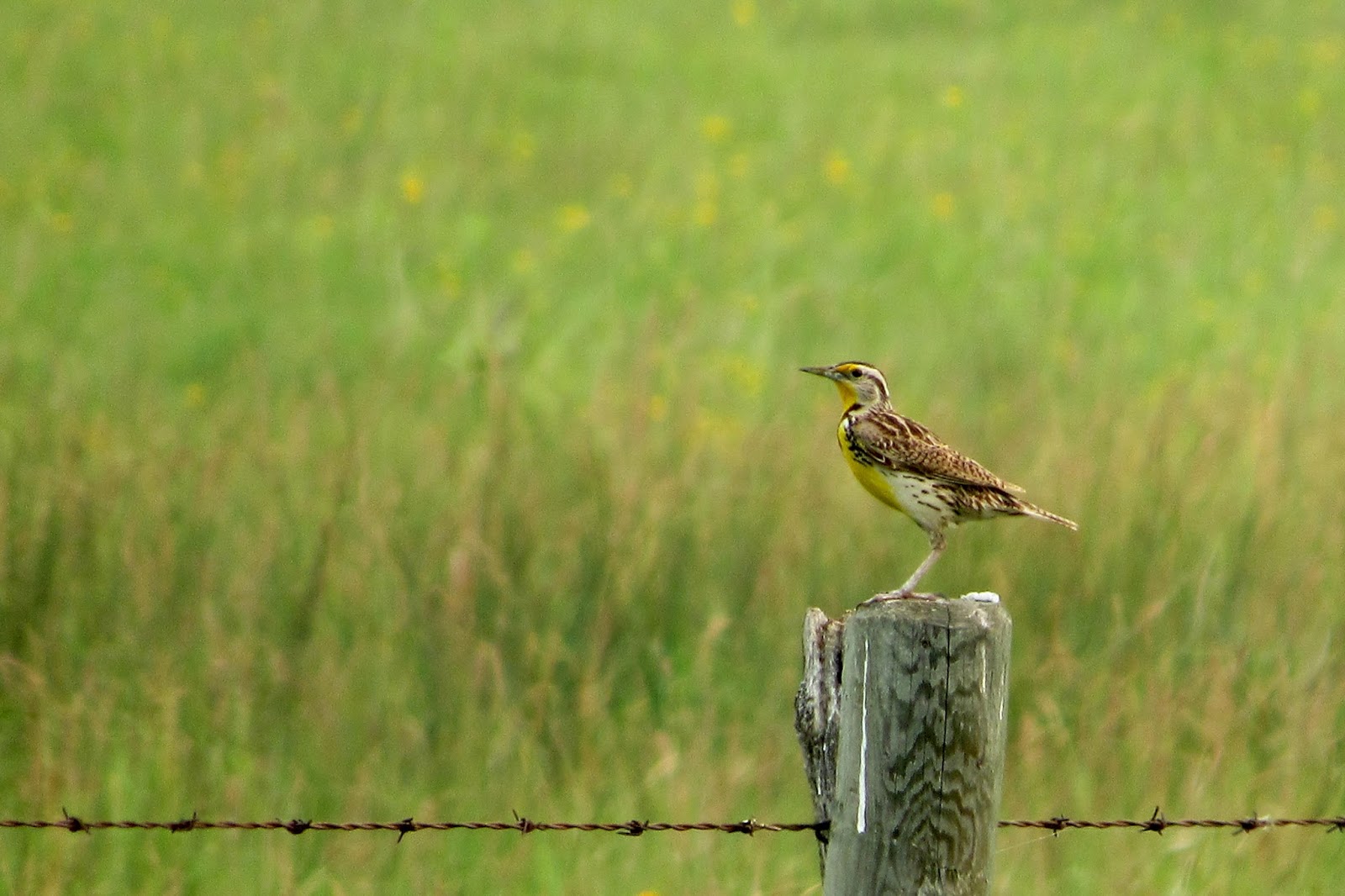
•    Gophers and meadowlarks
•    Electrical sockets in parking lots for block heaters
•    Sloughs and bluffs
•    Fallow fields
•    Grain elevators (there are some old ones still standing)


•    Super long freight trains
•    Hawks.  Lots of hawks.  More hawks in two weeks than I see in a year in Sackville.
•    Wildflowers everywhere: clover, Indian paintbrush, wood lilies, anemone, prairie smoke, harebells, black eyed Susans, gallardia, and a gazillion others


•    One million dragonflies
•    Endless blue, blue skies... with the fluffiest white clouds.... that go on forever
•    Cities and towns that suddenly turn into wheat fields, and wheat fields that suddenly turn into cities and towns
•    Roads and streets that go north-south or east-west.  Most of the time, you can figure out where you are.
•    Riding Mountain National Park
•    Whiskey jacks

•    Oil pumps
•    Thunder and lightning
•    Summer evenings that last forever, with a sun that takes forever to set.  At 10:15 p.m. a week ago, the sky was still light.
•    Beaver dams
•    Driving through flat prairie, rolling hills with tree bluffs, and forest all in the same day


What I don’t miss:
•    Horseflies
•    Hornets/wasps
•    Ticks

Wednesday, 17 June 2015

Sounds of life

This morning, while I was walking on the edge of the marsh, I was reminded of this column I wrote several years ago.  In its original form, it was published in Mount Allison University’s student newspaper, The Argosy, as a guest writer for Through Stained Glass, the weekly reflection from the University Chaplain (whom I happen to know!).

Like pretty much anywhere in North America, bikers and runners are fairly frequent sights on our streets and roads.  I often see them near my home and out on the marsh.  Almost always, they are listening to some form of electronic device.  Young people, likewise, always seem to be plugged into their tunes.  In order to even start a basic conversation, you must wait for them first to notice you, and then to take out their ear buds. 

This morning, I went for a walk on the marsh.  I made a conscious effort to listen as I walked along the path.  These are the sounds I would have missed if I had been plugged into my iPod (yes, I still have an iPod!).  The sound of the water lapping at the edge of the lake, thanks to the heavy northwest breeze.  Someone mowing their lawn.  Cattle bawling as the tractor brought their morning bale of hay.  The squishing of their feet as they walked through the muddy farm yard.  The breeze in the newly formed leaves and the unmown hay.   The clear, sweet song of the song sparrow.  A robin chirping.  The water from the stream gently passing under the bridge.  The distant sound of traffic on the highway.  The loud buzzing of a very large bumblebee.  My own breaths.  And above everything, the soft, high whistles of cedar waxwings.

If I were walking in an urban downtown, I would have heard different sounds.  Perhaps car brakes, the sound of many feet pounding the pavement, car horns and engines, the squeaking of a traffic light waving in the wind, a cell phone (or 9 or 10) ringing,  doors opening and closing, the voices of people in conversation with companions (or with themselves), coins rattling in a tin can held out by a panhandler.  “The music of the traffic in the city,” as Petula Clark says in her classic song “Downtown.”

Listening helps us to connect with our surroundings.  So does the sense of smell.  In Sackville, we sometimes smell the salt air, which reminds us of our proximity to the Bay of Fundy and ultimately the Atlantic Ocean.  Out where I live, we frequently smell farm smells.  Mostly, it is bearable, and sometimes, like the when we pass a tractor pulling a very full tank of liquid manure, it’s enough to make our eyes water and our lungs gasp for fresh air.  I have often said that the every day smells of the barns don’t bother me at all.  They represent the honest, hard work of producing food, and remind us of our connection to our agricultural roots.

We are all guilty of being “plugged into” things that prevent us from connecting with our surroundings.  If it isn’t the seemingly ever–present music device, it is a mobile phone ear piece, or perhaps a social networking site on our laptops, or in the case of parents, maybe we are “plugged into” our children, or our careers, or the stress of trying to accomplish all the tasks in our busy lives.  We are so connected with our technology and our own lives that we become disconnected from our surroundings, and more importantly, from the people surrounding us. 

The Chapel on the Mount A campus is one place which helps us reconnect with our surroundings and those around us.  On any given day in the Chapel, there are a myriad of sounds that can help us connect with other people, with ourselves and with that which is bigger than any of us.  I always think of the Chapel as a quiet place, until I go in during an organ student’s practice time.  There is something about the largeness of the chapel that seems to inspire organists to open up the stops as much as possible, and the result is so much loudness that it is sometimes scary.  Other times, it is so quiet you can hear the occasional voices of people outside.  I have listened to the wind against the stone walls, and the rain against the stained glass.  I have heard the voices of choirs and soloists, the notes of flutes and trumpets, the strumming of guitars, and the lovely mellow tones of a euphonium echo off the sandstone walls. You can always hear the heavy doors squeaking closed when someone is late for chapel, no matter how carefully they enter.

Sackville’s own poet laureate, Douglas Lochhead, wrote:

life
is listening

is finding
sounds

is feeling
rhythms

in all
things

life
is waiting

is standing
here and there

is saying
words

is praying
everywhere

I hope today, wherever you are, you have the opportunity to find the sounds and feel the rhythms that connect you with the world and the people around you.


Sunday, 17 May 2015

Fox River

I’ve been more neglectful than usual in finishing up a post (and that’s saying something!).  I was working on a reflection of Mother’s Day and motherhood, and it wasn’t coming together the way I wanted it to, so I put it aside.  My intention was to finish it this weekend, and post it.

Instead, I am writing about Prince Edward Island.  Again.  We were here just about a year ago, and at that time, I wrote about how magical a place this is for me.  I honestly had no intention of writing about PEI this weekend. 

But circumstances change.  I discovered, when we checked in to our cottage yesterday, that this will be the last summer we will be able to rent it.  The owners have been wanting to retire for some time now, and they have decided this is the year.

Once in a while, if you’re lucky, you find somewhere that immediately feels special, where you feel an instant connection with the place, the scenery, the ambiance.  I have been fortunate enough to find places like that several times throughout my life.  Fox River is one.

Fox River Cottages are owned by Belinda and Glen Machon, in Murray Harbour, Prince Edward Island.  History runs deep here.  There have been people living in this area at least since the Acadian Expulsion in 1755; likely both the Acadians and Mi’kmaq had settled in this area at some point before then.  Machons were among a group of immigrants from Guernsey in 1806.  Like much of PEI, agriculture has played an important part in the life of Murray Harbour, but the dominant culture here is the sea.  There are at least half a dozen wharves within a 5 or 6 minute drive of the cottage.  As I write this, it is lobster season, but mussels, tuna, clams, oysters and crabs are also caught in season.  The lore of the sea holds a certain romantic appeal for me, growing up as I did mainly in the landlocked prairies, and one of the most enjoyable things about Fox River has been watching the fishing boats coming and going, and hearing the pulse of their engines early in the morning and throughout the day.

I think the first time we stayed here was almost exactly ten years ago.  We were looking for somewhere special to celebrate our 20th anniversary, and my husband happened upon the web page for Fox River.  It looked quiet, and lovely, and peaceful, and it was affordable.  When we arrived, it felt like home.

Since that first visit, I have been back several times.  I came with my kids, my parents and my brother’s family one year, and at various other times, I have brought my daughter, friends, and my husband.  I haven’t been here every year, but I have probably been here at least ten times in the past ten years.  I have recommended Fox River to many people, in the hope that they would find it as peaceful and relaxing as I have.

This place has been a haven for me.  I have spent some of the most near-perfect days in this place.  One afternoon in particular will always stand out in my mind.  It was June, and I came with a friend.  My friend had other plans, so she left me at the cottage by myself.  It was a perfect sunny, warm day.  I spent the day sitting on the deck watching the lobster boats, and when it got too hot, I moved into the screened in porch.  I walked on the beach, ate when I felt hungry, read, and had a nap in the sunshine.  I was completely alone and I loved every second of it. 

During our visit last year, the weather was uncooperative.  It was cool and rainy, and we were pretty much confined to the cottage.  While my husband bemoaned the lack of good cycling weather, I curled up in the porch with a blanket, a stack of books, and a hot cup of tea, and spent the time watching the lobster boats and the bird life.  It was another almost perfect day. 

We have been lulled and soothed by the rhythm of the ocean tide, the sound of the waves on the shore and the boats in the water.  We’ve found hundreds of blue starfish on the beach here, as well as mussel, oyster, clam, snail, and scallop shells, beach glass, and the shells of crabs.  We’ve watched herons, osprey, bald eagles, terns, cormorants, gulls, and rabbits.  Ironically, although PEI is noted for its abundance of foxes, and we’ve seen foxes many times on the Island, we have never seen one at Fox River (edit: the day after I posted this, a little fox trotted along the shore). 

I am sure there are hundreds of other wonderful, peaceful, and beautiful places here on PEI.  And maybe we will find another cottage where we will want to return year after year.  But I can’t imagine any of them will evoke the same feelings as Fox River. 

I’m hoping to squeeze one more visit in the fall before they close for the last time.  I don’t know if it will happen.  I am happy for the Machons, that they are taking the time to do the things they have always wanted to do.  They are lovely people, and they deserve their retirement.  I am exceedingly grateful for the chance encounter on Google that originally brought us here, and I am grateful for the opportunities I’ve had over the past years to retreat to this lovely haven.  I will miss Fox River Cottages, and I will treasure my memories of time spent in this place.

Sunrise at Fox River (photo courtesy of John Perkin)